


No products in the cart.
December 18, 2025
A vast winter landscape stretches out beneath a high, cold sky. In the far left foreground, three hunters are coming down the slope. You can see how exhausted they are. Their bodies are leaning slightly forward, their steps are heavy, and even the dogs look tired, exhausted and starved. Their prey is meagre, just a small animal, a fox, hanging from a pole.
Further down, behind the village, a wide expanse of ice opens up, where life suddenly seems lively and playful. Children pull sledges, adults skate, someone falls, someone else carries goods across the ice.
Bruegel's Hunters in the Snow shows winter at that time in all its harshness. But also as a world of its own, in which social life took place.
In the mid-16th century, winters were exceptionally cold – much colder than we experience today in Central Europe. Rivers froze over for weeks or even months. Canals and lakes became so reliably frozen that they could be crossed by carts. In the Netherlands, where canals and waterways crisscross the entire country, the water network was transformed in winter into an extensive network of ice roads.
Winter became a season that determined everything: food, work, trade, mobility. Food in particular was a constant battle against scarcity. Supplies had to last until spring, and that was by no means guaranteed. The cold had far-reaching consequences for agriculture and the economy. Crop failures were more frequent, growing seasons were shorter, and some regions suffered from recurring famines.
But for people, the frozen state of the landscape was not merely an obstacle. When the waterways froze over, new routes emerged. Markets were held on frozen lakes, which enlivened community life in unexpected ways. Ice skating, sled races, other games and competitions became part of village life, which would not have been possible without the stable ice.
All this made winter, despite its severity, a social season. Pieter Bruegel the Elder's Hunters in the Snow captures with extraordinary insight how deeply winter affected people's lives.
Bruegel created the painting in 1565 for Nicolaes Jonghelinck, a wealthy Antwerp art collector and financial administrator. Jonghelinck owned several works by Bruegel and commissioned a series of large-format monthly paintings for his country house. These depicted the seasons, rural life and everyday human existence in harmony with the rhythms of nature. Originally, there were six panels, each covering two months. Hunters in the Snow represents December/January.
The paintings are all approximately 120 × 160 cm in size and are said to have hung all around Jonghelinck's dining room. The sight must have been magnificent for his guests.
Today, only five panels remain, three of which, namely Gloomy Day (early spring), Return of the Herd (autumn) and Hunters in the Snow (winter), are in the Kunsthistorisches Museum in Vienna. Early Summer, The Hay Harvest, can be seen in Prague at the Lobkowicz Palace in Prague Castle, while Late Summer, The Corn Harvest, is owned by the Metropolitan Museum of Art in New York. Spring was probably lost as early as the 17th
Hunters in the Snow is considered the best known of these monthly paintings and one of the most famous winter paintings in art history. It is the most atmospheric work in the series. The contrast between the exhausted homecoming in the foreground and the lively activity on the ice, the mixture of austerity and liveliness, immediately catches the eye.
But the real reason why this painting has become an iconic work lies in the way Bruegel guides the viewer's gaze, how he constructs space and how he combines the everyday with incredible narrative depth.
What makes the painting special is its viewpoint. Bruegel raises the horizon extremely high and allows us to look down on the landscape from a slope, as it were. We are not in the middle of the action, but neither are we far enough away to be detached. We are observers – much like Bruegel himself.
This composition forces our gaze in a clear direction. From the dark figures in the foreground, the hunters, and the dogs, it glides down to the bright village, continues across the ice and finally to the distant mountains. Many art historians therefore describe this painting as one of the most sophisticated examples of visual guidance in the Dutch Renaissance.
And then there are the details! You get the feeling that every little spot in the painting tells a little story: the man slipping on the ice, the woman gathering brushwood on the bridge, children playing with sledges, women by the fire, the lonely bird on the bare tree.
Behind the church, you can see a building with smoke rising from it. A group of people seem to be trying to extinguish the fire or save what can still be saved. On the other side of the river, a figure is carrying a long ladder across the ice. He is probably heading for the burning house.
Winter fires were a real danger, and attempts to extinguish them were desperate because the water was frozen.
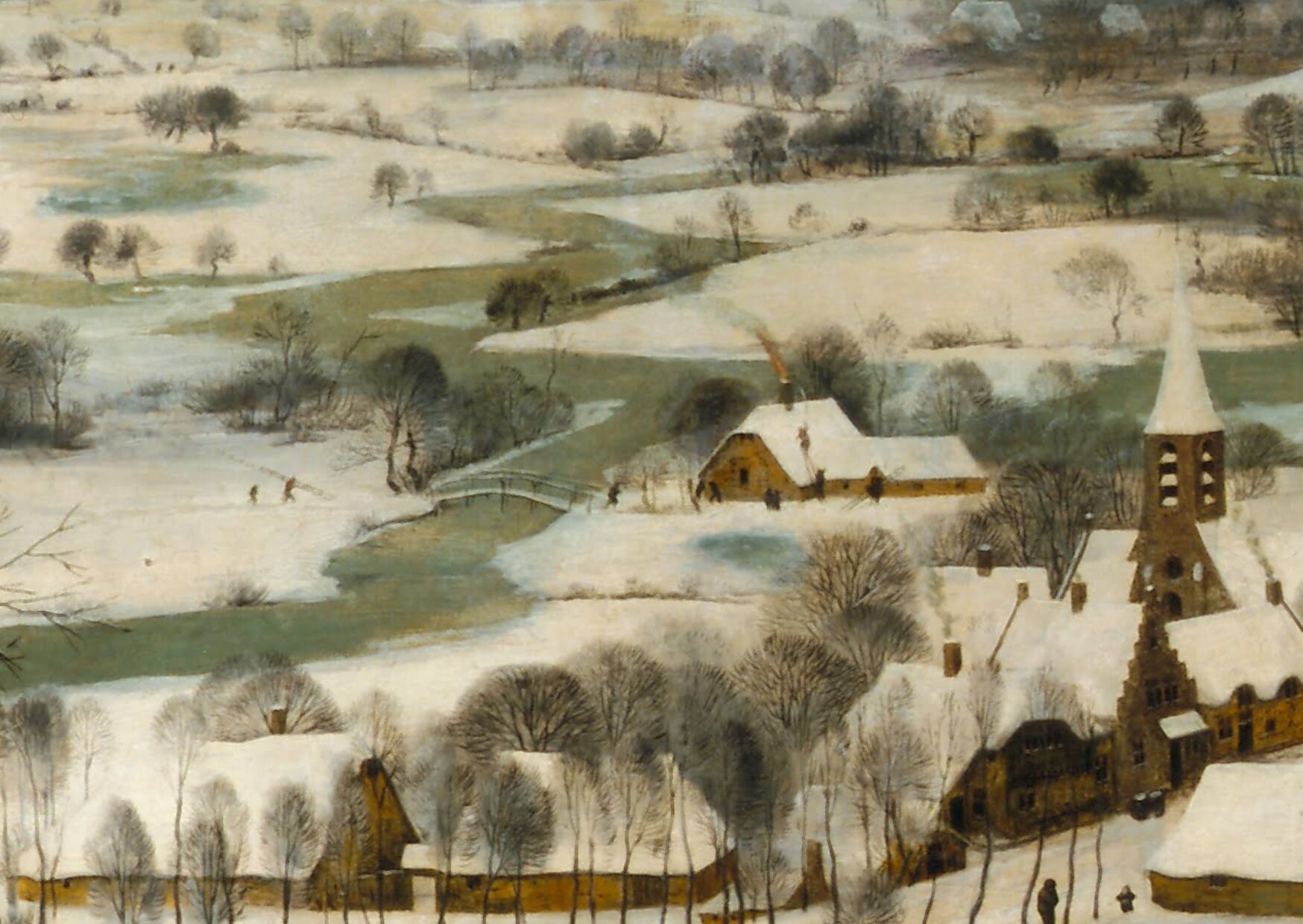
Hunter in the Snow, Detail
Beyond the large ice surface, a lone hunter shoots at birds, possibly ducks. If you look closely, you can even see the gunfire.
And on the ice, there are several groups of children who are not only pulling sledges, but also playing with iron tyres, sticks, or round discs – some of which are games that are hardly comprehensible today.
Bruegel documents folk culture here.
Despite its richness, the picture does not appear overloaded. Everything fits together harmoniously. The tranquillity, the winter silence, is preserved. Bruegel's art is an invitation to look closely.

Hunter in the Snow, Detail
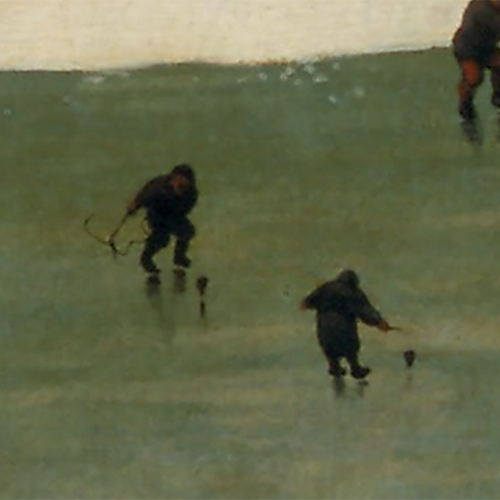
Hunter in the Snow, Detail
In the mid-16th century, winters were not just particularly cold; there was a period that we now refer to as the Little Ice Age. Roughly speaking, it began in the 13th century and lasted until around the end of the 19th century, but it reached its peak during Bruegel's lifetime.
Geographically, the Little Ice Age mainly affected Europe, North America and parts of Asia. It was particularly noticeable in Northern Europe: in the Netherlands, present-day Belgium, Northern Germany, Scandinavia and the British Isles.
In the 16th and 17th centuries, a new form of painting developed in the Netherlands, moving away from major religious themes towards everyday life, landscapes and bourgeois life. People wanted to see paintings that reflected their own world. And in winter, this world largely took place on the ice.
Between the late 16th and 17th centuries, no other region in Europe produced as many winter landscapes as the northern Netherlands. While Italian, French and Spanish artists tended to treat winter as a marginal motif or symbolic episode, Dutch painters made it an independent, recurring theme in their work.
The country was flat, rich in water and crisscrossed by canals. When these froze over, life changed completely. Winter offered clear contrasts, graphic structures, a reduced colour palette and, at the same time, an infinite number of little stories.
Hendrick Avercamp is considered the winter painter of Dutch art, or at least the one who consistently made the winter motif his trademark. No other artist of his time dealt with winter as persistently, as comprehensively and as variably as he did.
Frozen rivers, canals, lakes, crowds of people on the ice – this is his terrain. His paintings are densely populated, detailed and cheerful.

Hendrick Avercamp, Ice-skating in a village, Rijksmuseum, Amsterdam
Bruegel's Hunters in the Snow also depicts cheerfulness, but it never dominates the landscape; rather, it is always embedded within it. This makes the vulnerability of humans palpable.
This begins with the size of the landscape. The people are small, placed almost casually in this vast winter world. The space does not belong to them. The slope, the sky and the frozen surfaces take up much more visual space than the figures. Even in the foreground, it is not the hunters who dominate, but the snow, the slope, and the trees. Humans are part of this landscape, not its benchmark.
This is a crucial difference to many Italian Renaissance paintings, in which the landscape is often a stage for humans. With Bruegel, it is the other way round: humans are an episode in the space of nature.
The mountains in the background of Hunters in the Snow have no real geographical connection to the region depicted; as mentioned, the Netherlands is flat. But Bruegel was one of the few Northern European artists of his time who had seen the Alps himself. On his trip to Italy in the early 1550s, he crossed the Alps, and this experience had a lasting impact on him. These mountain landscapes reappear repeatedly in his later paintings.
In Hunters in the Snow, the mountains enlarge the space enormously. They draw the eye backwards, opening up the picture and giving it a depth that extends beyond village life. This makes the landscape seem even more powerful, even more comprehensive – and the people in it even smaller.
Then there is this barrenness. Not dramatic, silent. Hardly any foliage, bare trees, muted colours, in contrast to the crows – almost like harbingers of death. The visual restraint creates a feeling of deprivation. The world has little to offer at the moment. The fact that the hunters return almost empty-handed is not a narrative climax, it is a matter of fact.
The tavern sign hangs crookedly above the heads of the people sitting around the campfire. It is unstable, moved by the wind, not firmly anchored. It looks as if it could fall down at any moment. A small image of the uncertainty of human existence. At the same time, it shows a religious vision of hunting that has nothing to do with the reality beneath it. This, too, is vulnerability: the distance between ideal and life.
The posture of the people implies a subtle but physically palpable form of vulnerability. No one is standing upright. The hunters are bent over, the people on the ice are slipping, stumbling, balancing. Even in play, their bodies are uncertain. The ice bears their weight – but only under certain conditions. One wrong step and you fall. Nature allows movement, but it guarantees nothing.
The fire in the background is also part of this. A house catches fire while everything else is frozen. Water is there, but it cannot be used. People are dependent on elements beyond their control. Cold does not protect against disasters; it even exacerbates them. The fact that this scene is so small does not make it any less significant – on the contrary. It shows how casually existential threats could arise in everyday life.
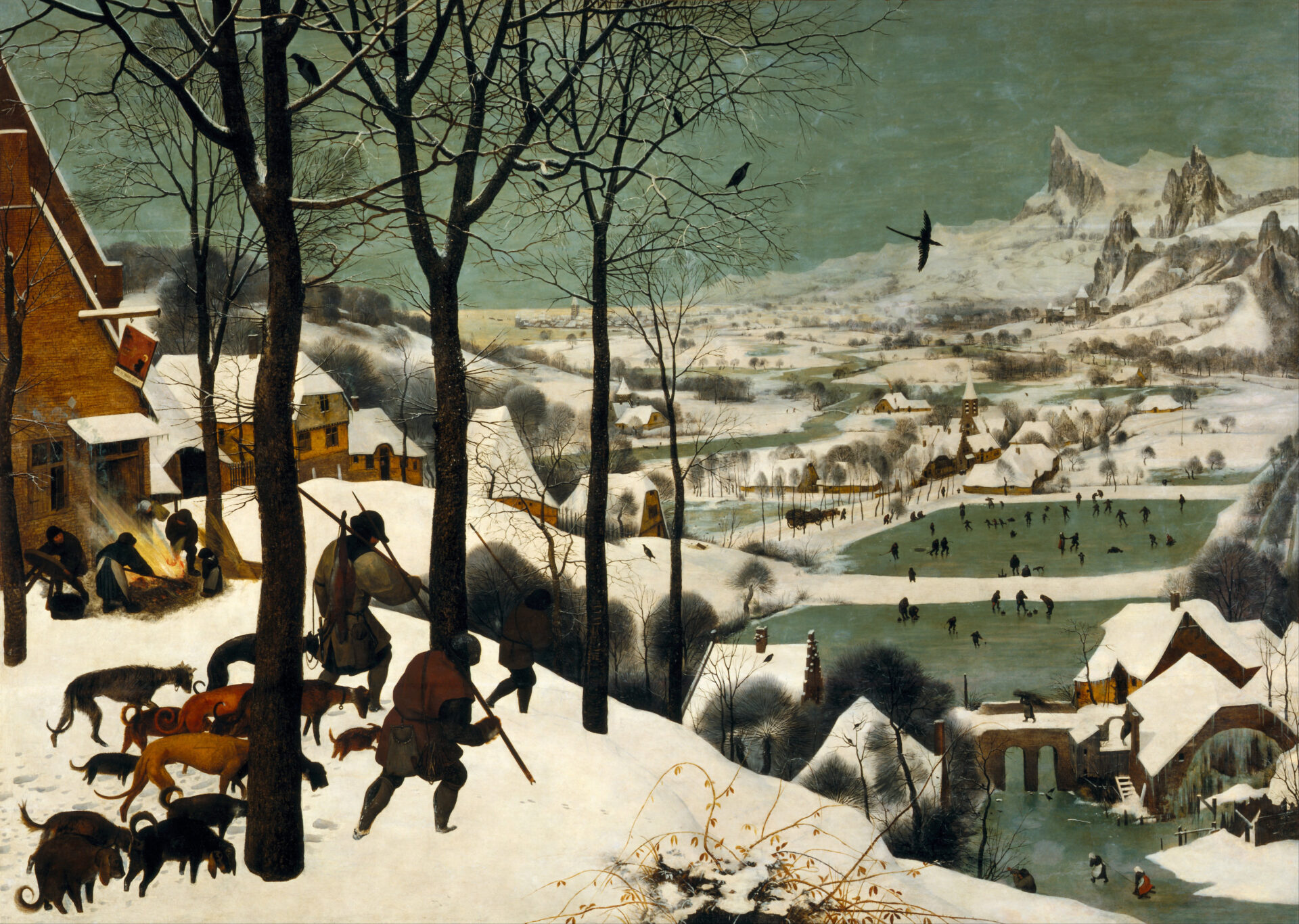
Pieter Bruegel the Elder, Hunters in the Snow, Kunsthistorisches Museum, Vienna
In his painting, Bruegel documents the climate without seeking to explain or name it. Not in a scientific sense, but in an existential one. He captures how climate feels, how it shapes everyday life and how people navigate it. Not in collapse, but in constantly adapting to conditions that are greater than themselves.
The painting, with its tranquil, snow-covered landscape and lively ice scenes, corresponds to what we associate with the Christmas spirit today, even if Bruegel himself did not have this in mind.
Since the 19th century, classic winter landscapes have been increasingly used in reproductive art. Hunters in the Snow is one of the most famous classic winter paintings in the world and is often printed on postcards and Christmas cards. A popular myth even claims that it is the most common secular Christmas card motif worldwide.
Of course, this cannot be proven. But that doesn't stop me from wishing you a Merry Christmas with this motif as well.
Join the newsletter now
and not miss a thing
Get exclusive insights into my creative processes, learn the stories behind my artwork
and receive invitations to my exhibitions and events.
To say thank you, I'll give you 10% off your first purchase.