


No products in the cart.
November 27, 2026
I'm not exactly sure what it is about views of rooftops that fascinates me so much. Just the mention of red-tiled roofs is enough to make me feel the Italian sun on my skin.
The view across a city's rooftops stirs a longing in me that's hard to explain.
Caillebotte also looks down on rooftops from above. But instead of sunshine and warmth, he shows us snow and gray walls. You can almost feel the cold. And even though we don’t see the Eiffel Tower or any of the other famous landmarks, we know right away: we're in Paris.
The Parisian rooftops are unmistakable. This is mainly due to the combination of mansard roofs, small dormers, and the numerous chimneys with their terracotta-coloured caps.
But it is especially the silver-grey zinc roofs that give the city its own unique colour palette, even in the sunshine.
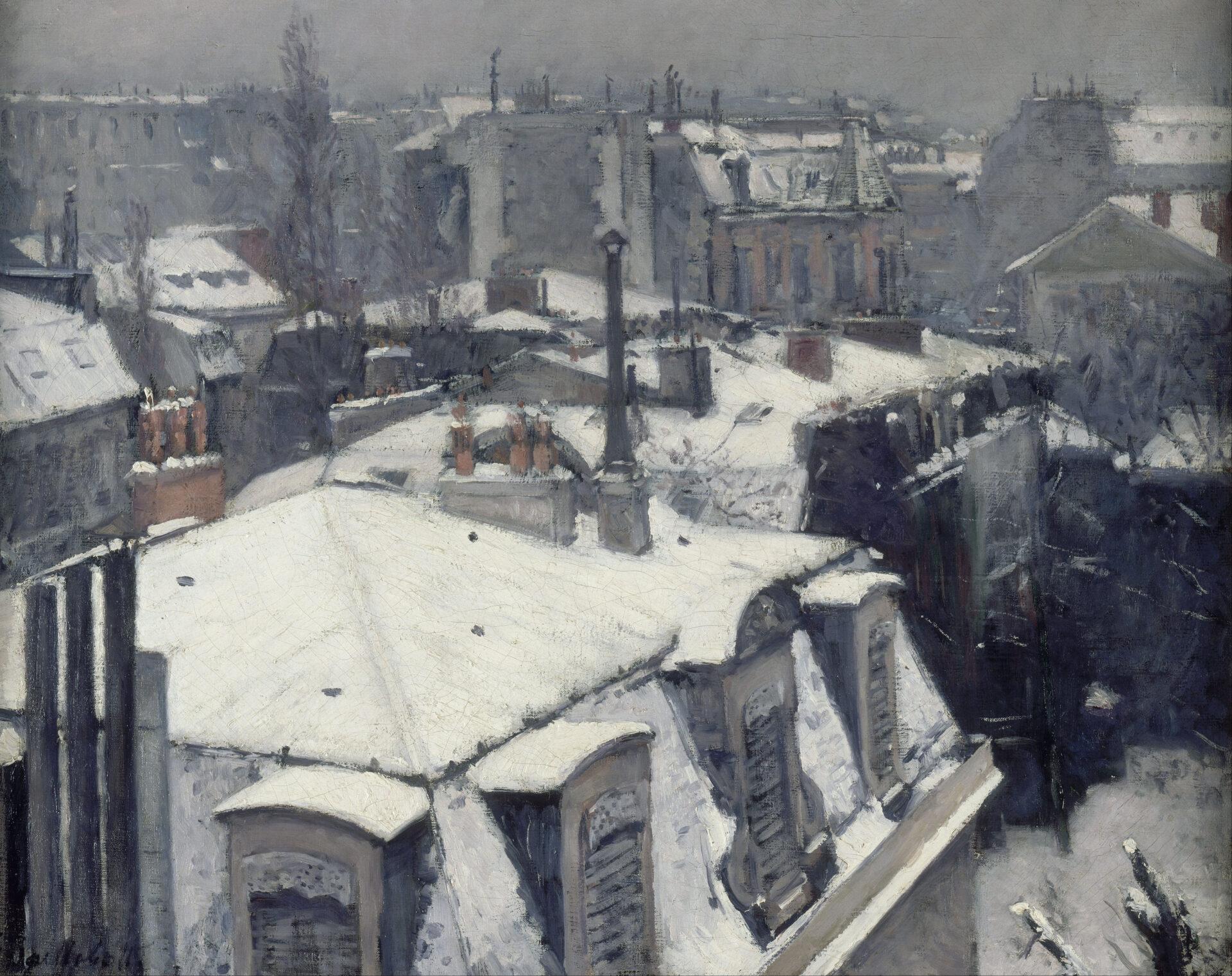
Snow-covered Roofs, Gustave Caillebotte, 1878, Musée d’Orsay, Paris
What makes Snow-covered Rooftops particularly interesting is that Caillebotte's painting has no clearly defined main subject. Our gaze wanders across the rooftops, pauses at individual chimneys, follows the edges of the roofs and eventually loses itself in the distance.
From an elevated viewpoint, we look down at the city at an angle. The streets are largely hidden from view. Instead, we see a tightly packed cluster of buildings of varying heights. The sky occupies only a small part of the composition.
The numerous sloping roofs, vertical chimneys and horizontal edges of the buildings form a complex geometric structure. The chimneys interrupt the diagonal lines of the roofs, creating a rhythm of their own through repetition.
At first glance, the painting appears almost monochromatic. On closer inspection, however, we discover various shades of grey and brown, hints of blue, ochre and a delicate pink. The snow, too, is far from simply white. Caillebotte does not paint a pristine, brilliantly white winter landscape. He depicts snow as we encounter it in a large city: unevenly distributed and dirty.
The diffuse winter light produces hardly any distinct cast shadows. The more distant buildings gradually lose definition and contrast, creating a sense of spatial depth despite the density of the buildings.
Although we are in the middle of a large city, there is not a single person in sight. The composition is dominated almost entirely by architecture, snow and sky. This contributes greatly to the peculiar stillness of the painting.
Caillebotte painted the 64.5 × 81 cm oil painting in 1878. The following year, he presented it alongside another rooftop view and several other paintings at the fourth Impressionist exhibition. Both rooftop views received little attention from critics at the time. A collection of grey rooftops without human activity, grand architecture or spectacular lighting conditions perhaps offered little of what audiences of the time typically found appealing in a landscape painting.
Following Caillebotte's death in 1894, his brother Martial donated the painting to the French state. Today, it forms part of the collection of the Musée d’Orsay. Thanks to this donation, Snow-covered Rooftops was for decades one of the few paintings by Caillebotte accessible to the public, as most of his work remained in the family's possession for many years.
Gustave Caillebotte (1848–1894) came from a wealthy Parisian family. He was financially independent and able to devote himself to painting without having to make a living from selling his work. He purchased paintings by Monet, Renoir, Degas, Pissarro, Sisley, Cézanne and Manet, among others. In doing so, he supported artists who, at the time, were often struggling to make a living from their art.
Caillebotte shared the Impressionists' interest in contemporary life, everyday subjects and the depiction of light and atmosphere. Above all, he shared their desire for independence from the academic art establishment. They wanted to decide for themselves what constituted a subject worthy of art and how it could be depicted.
His support went far beyond purchasing paintings. At times, he paid Monet's rent and repeatedly lent money to both Monet and Renoir. He helped finance and organise the Impressionist exhibitions and exhibited his own work at five of the eight exhibitions between 1876 and 1882.
His role as a collector was of considerable significance to French art history. As early as 1876, at the age of just 28, Caillebotte drew up a will stipulating that his art collection should pass to the French state upon his death.
However, he did not simply want to give away his collection. He wanted to ensure that the works of his fellow artists were publicly exhibited and recognised as significant works of art.
In his will, he expressly stipulated that the paintings should end up neither in an attic nor in a provincial museum but in the Musée du Luxembourg in Paris, then the museum of contemporary art, and later in the Louvre.
When Caillebotte died on 21 February 1894, at the age of just 45, his collection comprised more than 70 works.
In his will, Caillebotte had insisted that the entire collection be put on public display. However, the Musée du Luxembourg did not have sufficient space.
His brother Martial and Auguste Renoir, whom Caillebotte had appointed as executor of his will, insisted that his wishes be respected. After lengthy negotiations, an agreement was finally reached allowing the state to accept 40 works on the condition that they were actually exhibited. The remaining works stayed in the possession of his heirs.
On 9 February 1897, the specially created Salle Caillebotte opened at the Musée du Luxembourg. At the time, such an extensive display of Impressionist art in a public museum was unprecedented anywhere in the world.
Among the works that entered the French national collections through Caillebotte's bequest are paintings that are now world-famous, such as Auguste Renoir's Dance at the Moulin de la Galette, Claude Monet's The Saint-Lazare Station and Édouard Manet's The Balcony.
Caillebotte's bequest, however, did not include a single work of his own.
He seems to have held the artistic achievements of his fellow painters in higher regard than his own. According to Jean Renoir, the son of Auguste Renoir, he once said, 'I try to paint honestly and hope that one day my works will be good enough to hang in the anteroom of the gallery where the Renoirs and Cézannes hang.’
Caillebotte had received academic training under the painter Léon Bonnat. He had mastered the classical rules of perspective and made detailed preparatory drawings for his paintings. At the same time, he was interested in modern life, everyday experiences and the changes taking place in the city.
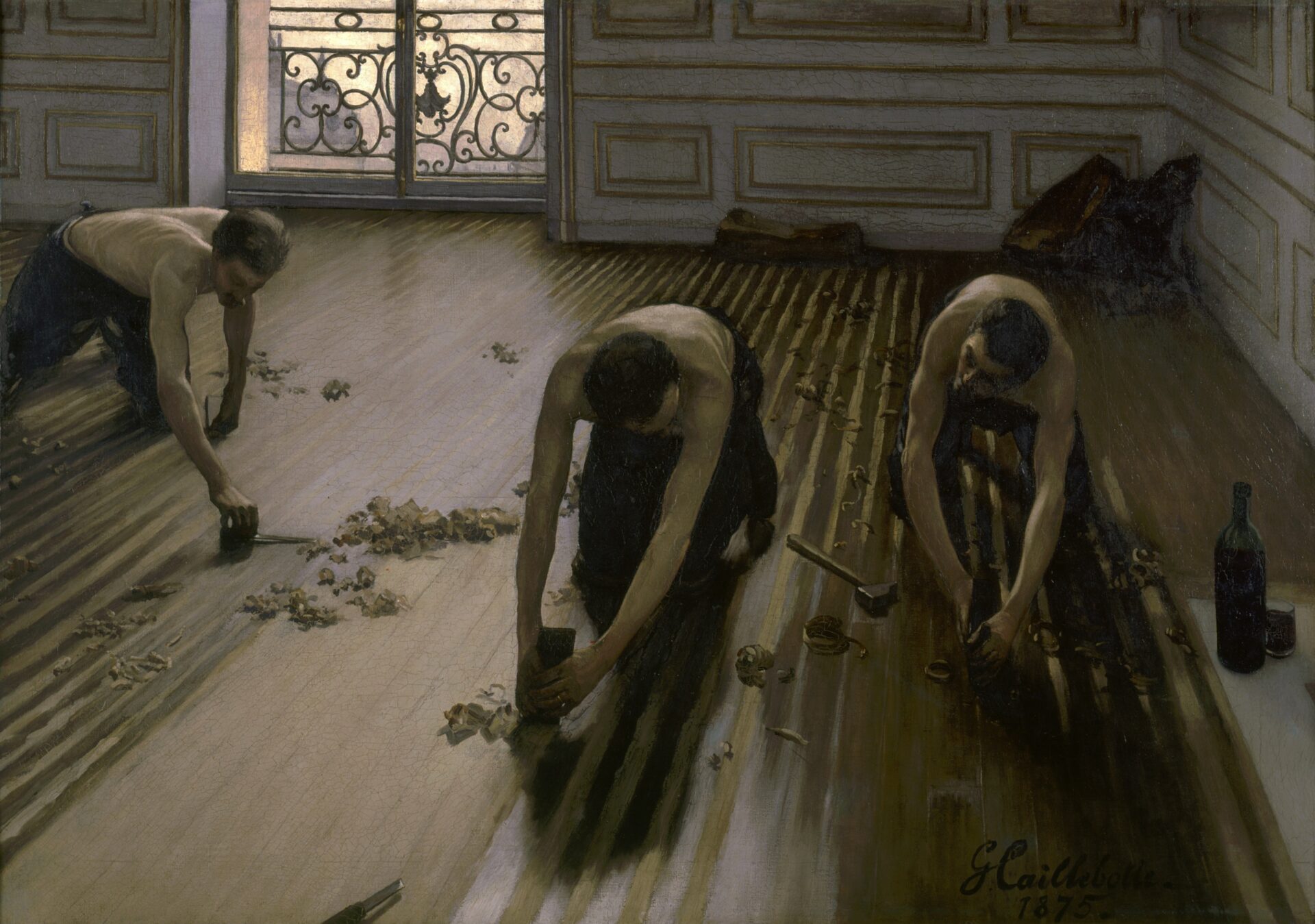
The Parquet Floor Sanders, Gustave Caillebotte, Musée d’Orsay, Paris
His 1875 painting The Floor Scrapers was rejected by the jury of the Paris Salon. The realistic depiction of men engaged in manual labour was particularly unusual in academic painting at the time.
Caillebotte's modernity lay less in his painting technique than in his choice of subjects and his unusual perspectives. He used the tools of academic painting to depict subjects that received little attention in academic art. Yet while his choice of subjects was too unconventional for academic painting, his manner of depicting them seemed too realistic to some advocates of modern painting.
According to Paul Perrin of the Musée d’Orsay, it was precisely this distinctive stylistic position that was one of the reasons why art historians struggled for so long to establish Caillebotte's place within Impressionism.
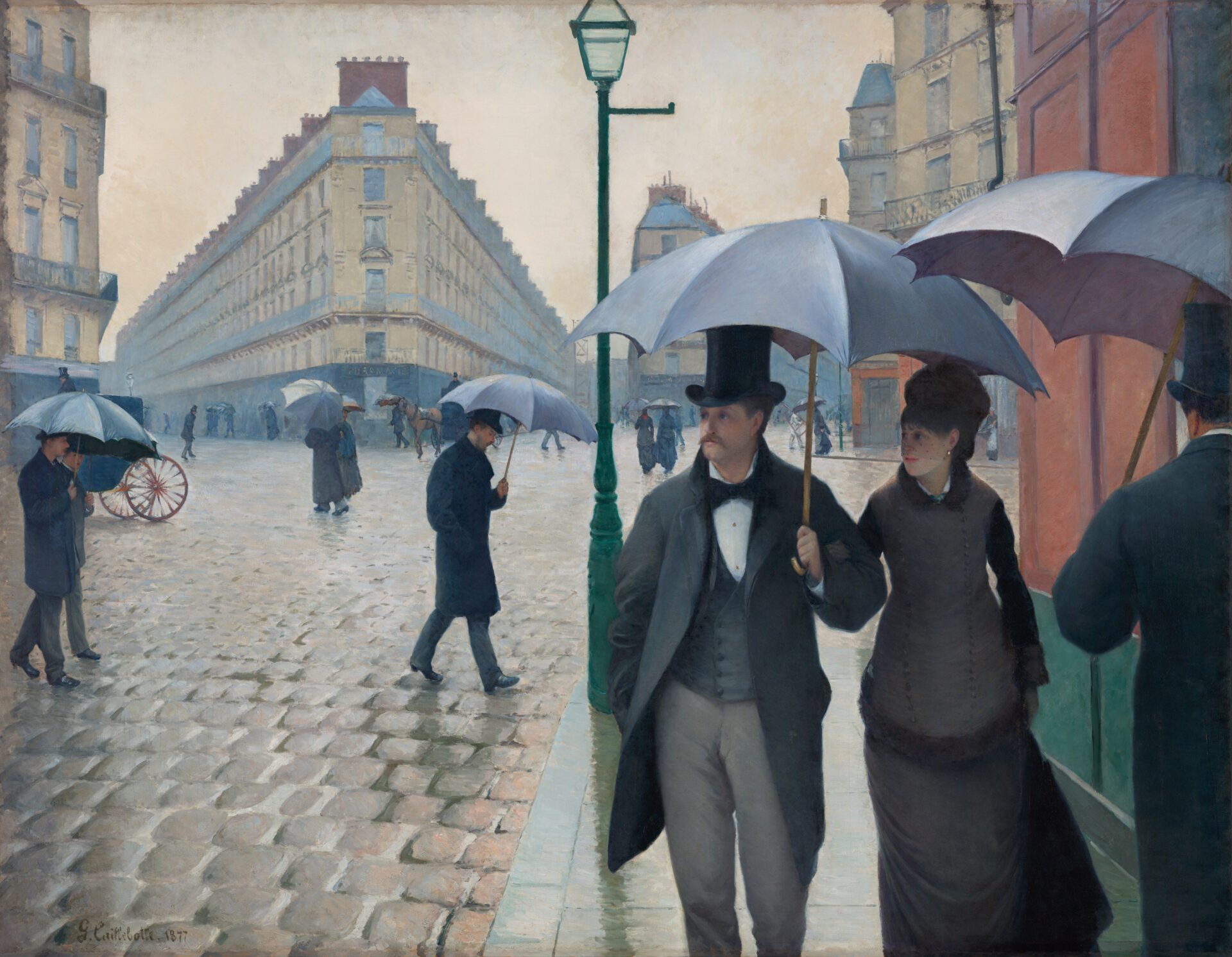
Rainy Street, Gustave Caillebotte, 1877, Art Institute of Chicago
In Paris Street; Rainy Day, as in Snow-covered Rooftops, we find the same carefully constructed perspective, the geometric organisation of the composition, the muted colours and an interest in the effects of weather on the urban landscape.
Unlike Monet or Renoir, who often painted comparable street scenes with much looser brushwork, Caillebotte retained the clearly defined contours of the buildings and figures.
When Napoleon III appointed Georges-Eugène Haussmann as prefect of the Seine department in 1853, much of Paris still consisted of narrow, winding streets lined with densely packed buildings. Sanitary conditions were often poor, the population was growing, and the existing infrastructure could barely meet the demands of the expanding city.
Paris had also experienced several revolutions and uprisings in the preceding decades, most notably the July Revolution of 1830, the February Revolution and the June Days uprising of 1848. The narrow, winding streets of the old city could easily be blocked with barricades, making military intervention difficult.
Between 1853 and 1870, wide boulevards were laid out, parks were created, and the drinking water supply and sewerage systems were expanded. Haussmann shaped not only the layout of the streets but also the appearance of the buildings. Building heights were proportionate to the width of the streets. Uniform façades, continuous balconies and similar roof shapes created a harmonious overall appearance.
However, this transformation also had social consequences. Before the redevelopment, people from different social classes often lived under the same roof in Parisian buildings. Wealthy residents occupied the grand apartments on the lower floors, while the small, modest rooms of domestic servants were situated beneath the roofs. The social hierarchy was thus reflected in the vertical arrangement of the buildings.
The demolition of entire streets led to a loss of affordable housing. Many of the newly constructed buildings were designed for a more affluent middle class. As a result, many low-income residents were forced to move to the outer districts, particularly in the north and east of Paris. This reinforced the existing social and spatial divisions within the population.
The new Paris also brought with it new ways of living and spending leisure time. Cafés, restaurants, parks, theatres and dance halls became popular subjects among the Impressionists. The city offered them a wealth of new subjects to paint.
Much of what we perceive as historic Paris today was modern architecture during Caillebotte's lifetime. While many Impressionist cityscapes capture the bustling life of the metropolis, in Snow-covered Rooftops, Caillebotte depicts a city that appears almost deserted without seeming uninhabited.
When I think of Impressionist painting, I usually picture sunlit landscapes and the interplay of light and shadow beneath trees. Yet even a grey winter's day offers a wealth of subtle variations in colour.
However permanent the city's architecture may be, its appearance changes with the weather, the time of day and the season. The essence of Impressionism lies in the fleeting.
In the diffuse light of a grey winter's day, the buildings gradually lose definition as they recede into the distance, the colour contrasts become less pronounced, and the rooftops seem almost to merge with the grey of the sky. Caillebotte combines carefully constructed geometric perspective with atmospheric perspective. In doing so, he captures how familiar surroundings can, under particular lighting and weather conditions, look quite different for a brief moment.
Join the newsletter now
and not miss a thing
Get exclusive insights into my creative processes, learn the stories behind my artwork
and receive invitations to my exhibitions and events.
To say thank you, I'll give you 10% off your first purchase.